
Chapter 1 Career Development

Career Development & Well-Being
In this section you will be provided with a summary of this chapter and review questions with answers and rationales to reinforce your learning.
“When employees feel a sense of personal well-being and career development, they are more engaged, productive, and committed to their work, leading to both individual and organizational success.”
Chapter Summary
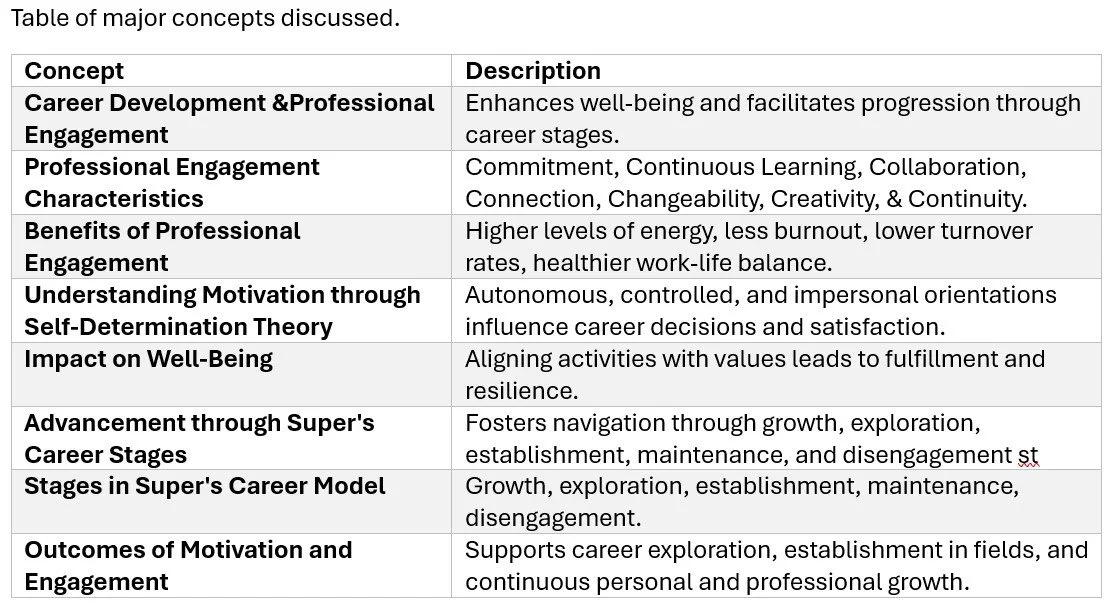
An intentional focus on career development, professional engagement, and motivation can significantly enhance well-being and facilitate progression through Super's career stages. Professional engagement, characterized by commitment, continuous learning, collaboration, and creativity, is linked to higher levels of energy and overall well-being. Research shows that engaged professionals experience less burnout and lower turnover rates, fostering a healthier work-life balance (Harter et al., 2002; Schaufeli et al., 2008). Understanding motivation, particularly through Deci and Ryan's Self-Determination Theory, reveals how autonomous, controlled, and impersonal orientations influence our career decisions and satisfaction. By aligning professional activities with personal values and interests, individuals can achieve greater fulfillment and resilience in their careers, positively impacting their well-being (Deci & Ryan, 1985; Leiter & Maslach, 2016; Saks, 2006).
Furthermore, this focus aids in advancing through Super's career stages—growth, exploration, establishment, maintenance, and disengagement. By fostering motivation and engagement, individuals can effectively navigate these stages, from developing a self-concept in the growth stage to seeking new challenges in the establishment and maintenance stages. Engaged and motivated professionals are better equipped to explore career options, establish themselves in their chosen fields, and maintain their positions while continuously seeking personal and professional growth. This alignment between motivation, engagement, and career development not only enhances well-being but also supports a fulfilling and dynamic career trajectory (Super, 1957; Savickas, 2002).

Review the multiple choice questions to support your learning.
-
What is a key aspect of professional engagement that positively impacts well-being?
A. Higher salary
B. Continuous learning
C. Job title
D. Office location
-
Which theory by Deci and Ryan helps to understand different types of motivation?
A. Maslow's Hierarchy of Needs
B. Herzberg's Two-Factor Theory
C. Self-Determination Theory
D. Expectancy Theory
-
According to Super’s career stages, what is the focus of the establishment stage?
A. Developing a self-concept
B. Exploring career options
C. Seeking new challenges
D. Preparing for retirement
-
What is a characteristic of individuals with an autonomous orientation?
A. They are driven primarily by external rewards.
B. They feel a lack of control over their actions.
C. They align their behaviors with their personal values and interests.
D. They avoid taking on new responsibilities.
-
Which of the following is NOT a characteristic of a motivated person as discussed?
A. Determined
B. Committed
C. Indifferent
D. Passionate
-
Engaged professionals experience which of the following benefits?
A. Higher turnover rates
B. Increased burnout
C. Healthier work-life balance
D. Lower job satisfaction
-
B. Continuous learning
Rationale: Continuous learning is a key aspect of professional engagement that contributes to personal growth and development, thereby positively impacting well-being.
C. Self-Determination Theory
Rationale: Deci and Ryan’s Self-Determination Theory explains different types of motivation, such as autonomous, controlled, and impersonal orientations.
C. Seeking new challenges
Rationale: In Super’s career stages, the establishment stage involves seeking new challenges and establishing oneself in a chosen field.
C. They align their behaviors with their personal values and interests.
Rationale: Individuals with an autonomous orientation engage in behaviors that match their interests and values and have high levels of intrinsic motivation.
C. Indifferent
Rationale: Indifference is not a characteristic of a motivated person. Motivated individuals are typically determined, committed, enthusiastic, focused, passionate, driven, and ambitious.
C. Healthier work-life balance
Rationale: Engaged professionals tend to experience a healthier work-life balance, which is associated with lower burnout rates and greater job satisfaction.
-
Deci, E. L., & Ryan, R. M. (1985). The general causality orientations scale: Self-determination in personality. Journal of Research in Personality, 19(2), 109-134.
Harter, J. K., Schmidt, F. L., & Keyes, C. L. M. (2002). Well-being in the workplace and its relationship to business outcomes: A review of the Gallup studies. Flourishing: Positive psychology and the life well-lived, 2, 205-224.
Leiter, M. P., & Maslach, C. (2016). Burnout and engagement: Contributions to a new vision. Burnout Research, 3(4), 185-189.
Saks, A. M. (2006). Antecedents and consequences of employee engagement. Journal of Managerial Psychology, 21(7), 600-619.
Savickas, M. L. (2002). Career construction: A developmental theory of vocational behavior. In D. Brown & Associates (Eds.), Career choice and development (4th ed., pp. 149-205). San Francisco, CA: Jossey-Bass.
Schaufeli, W. B., & Bakker, A. B. (2004). Job demands, job resources, and their relationship with burnout and engagement: A multi-sample study. Journal of Organizational Behavior, 25(3), 293-315.
Super, D. E. (1957). The psychology of careers: An introduction to vocational development. New York: Harper & Row.